
Inheriting AI Risk in M&A: Why HR Diligence Must Include AI Systems
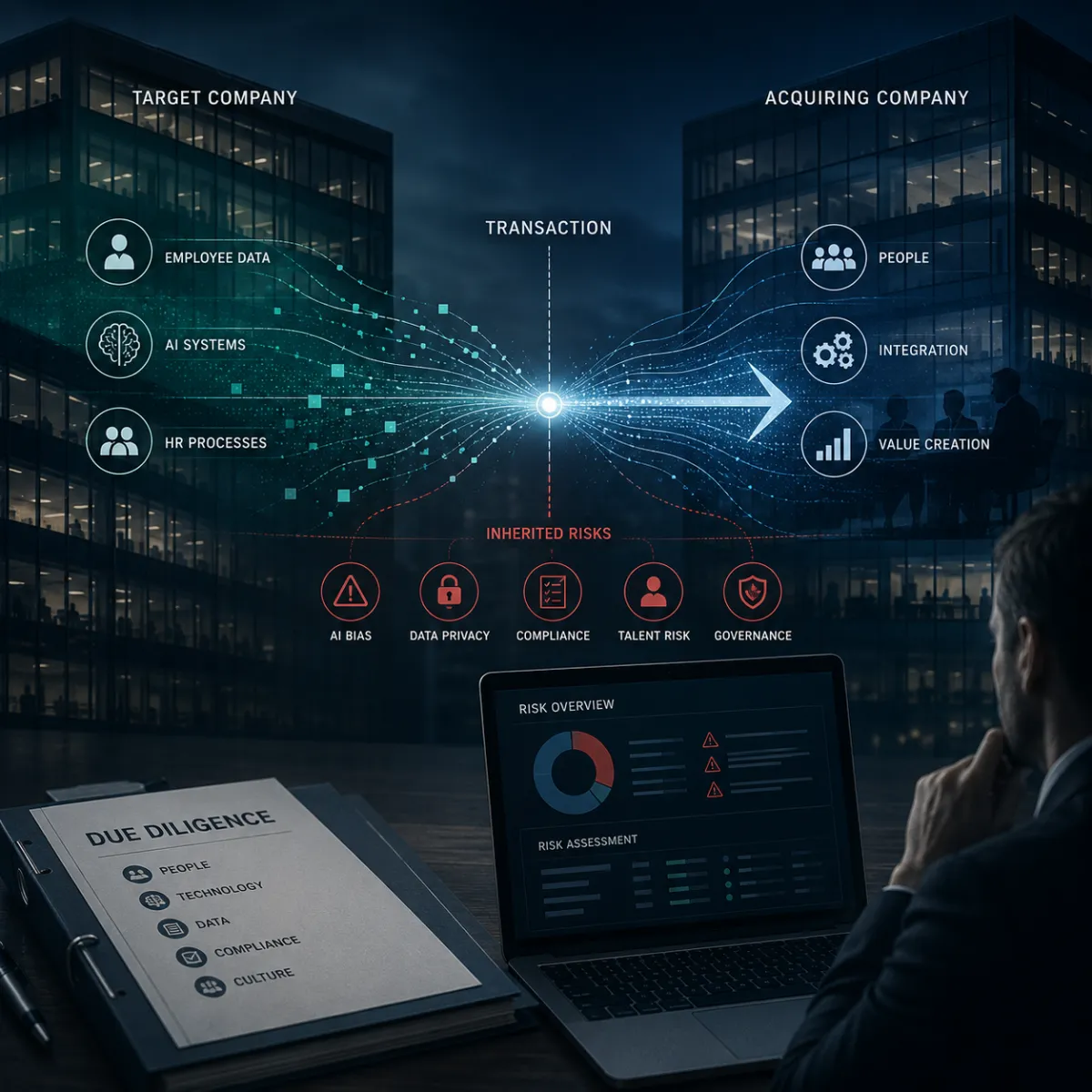
The artificial intelligence sitting on the other side of an acquisition is about to become your artificial intelligence.
That means the target's AI systems, vendor relationships, decision histories, data practices, and potential liabilities all need to be evaluated before the transaction closes.
Many organizations are already using AI to support hiring, performance management, benefits administration, workforce planning, and day-to-day operations. Yet AI systems are still frequently absent from the HR diligence checklist.
That omission does not eliminate the risk. It just means the acquirer may be buying the risk without identifying it, evaluating it, or pricing it into the deal.
This is the seventh and final of the Seven Deadly Sins of AI in HR M&A: inheriting AI risk you never diligenced.
The AI Risk You Inherit at Close
Most discussions about AI risk focus on how the acquiring company plans to use AI after the transaction. That is only part of the issue.
The target may already be using AI systems that affect employees, candidates, managers, and business decisions. Those systems can carry bias in employment-related decisions, unclear data lineage, regulatory non-compliance, limited human oversight, and inadequate documentation of how recommendations are made. Some of those systems may have been operating for years before your deal team ever saw a data room.
The day the transaction closes, those systems become part of the combined organization.
The acquirer does not inherit only the technology. It may also inherit years of AI-supported decisions, contractual obligations, regulatory exposure, and vendor dependencies that no one surfaced during diligence.
That is why AI needs to be treated as an active diligence category, not as a future integration issue.
A Clean HR Diligence Report May Still Miss AI Exposure
I've seen this pattern more than once. A target with around 1,200 employees goes through standard HR diligence. The teams review headcount, compensation, benefits, employment agreements, retention concerns, and labor matters. Everything comes back clean.
Six months after close, a discrimination claim surfaces involving the target's AI-supported applicant screening tool. The system had been making or influencing first-round hiring decisions for three years.
The vendor's bias audit is incomplete. The target never completed its own impact assessments. Documentation is limited, and no one can clearly explain the level of human oversight applied to the system's recommendations.
The acquirer did not simply inherit a software tool.
It inherited a vendor relationship, a three-year decision history, and a potential liability stream that never appeared on the original diligence checklist.
This is the danger of excluding AI from HR diligence. The risk does not remain with the seller just because the buyer failed to ask about it.
Put AI Explicitly Into the HR Diligence Scope
The first step is straightforward: ask the target which AI tools it uses.
The inquiry should go beyond whether the organization has a formal enterprise AI platform. AI functionality may be embedded in applicant tracking systems, performance tools, benefits platforms, workforce analytics products, and productivity applications. If a vendor solution touches employee or candidate decisions, it belongs in scope.
For each system, the diligence team should understand what the tool is used for, which decisions it influences, what data it receives or produces, who reviews its recommendations, whether a person can override its output, and which employees or jurisdictions are affected.
The goal is not to conduct a theoretical discussion about AI strategy. The goal is to build an inventory of systems already operating inside the target and understand how they affect people-related decisions.
Trace the Evidence Behind the System
Identifying the tools is only the beginning.
The diligence team also needs evidence showing how those systems have been evaluated, monitored, and governed. That means bias audit history, impact assessments, data lineage documentation, vendor contracts and service commitments, human oversight procedures, and records of testing and escalation processes. If the target cannot produce these, that tells you something important about how seriously it has managed its AI exposure.
The target should also be able to explain whether its vendors are capable of supporting an enterprise environment after the transaction. A system that was acceptable for a smaller organization may introduce real risk when it becomes part of a larger company with more employees, more regulatory obligations, and more complex governance requirements.
Vendor diligence is part of people diligence. The acquiring organization needs to understand not only what the tool does, but whether the vendor can provide the transparency, controls, and support required after close.
Treat Silence as a Diligence Finding
One of the most important principles I apply in AI diligence is that an incomplete answer is still an answer.
When a target cannot explain how an AI system makes or influences decisions, that lack of clarity should not be treated as a reason to move on. It is a finding.
The same is true when the organization cannot produce audit records, identify the data used by the system, explain the role of human review, or assign clear ownership. I have watched teams brush past these gaps because the diligence timeline was tight and the system "seemed fine." Those are exactly the gaps that surface as liabilities six or twelve months after close.
The appropriate response depends on the system and the level of risk. The buyer may require additional investigation, contractual protections, remediation planning, a change in valuation assumptions, or a decision to discontinue the tool after close.
The critical point is that the issue should be visible before the transaction is completed. You cannot manage risk you have not identified.
AI Diligence Protects Post-Close Value
AI diligence is not merely a compliance exercise. It supports post-close value creation by helping the integration team understand which systems can be retained, which require remediation, and which may need to be replaced.
It can also prevent avoidable disruption. Discovering a high-risk AI tool after close may force the combined organization to make rapid changes to hiring, performance management, or benefits administration. Those changes create additional work for HR, confuse managers, disrupt the employee experience, and undermine trust during an already sensitive integration period. That is Integration Debt accumulating in real time, and it is entirely avoidable with better diligence.
Addressing the issue before close gives leaders more options. HR, Legal, IT, Corporate Development, and integration leaders can evaluate the exposure together and develop a realistic plan before the system becomes the buyer's responsibility.
AI Provides Leverage, Not Accountability
AI can provide significant leverage across HR and M&A. It can accelerate analysis, identify patterns, improve access to information, and support more consistent execution.
What it cannot do is assume accountability for the decisions made in its name.
That accountability remains with the people leading the deal and the organization that owns the system.
The question for diligence teams is direct: do you understand the AI systems you are about to inherit? If the answer is no, that uncertainty belongs on the diligence report, not in a post-close surprise.
The Series in Perspective
This is the final installment in the Seven Deadly Sins of AI in HR M&A. Across this series, the through-line has been consistent: AI is a powerful tool for HR and integration teams, but only when it is deployed with the same rigor, judgment, and accountability that define good deal execution.
The sins I've covered are not theoretical risks. They are patterns I've watched play out on real transactions: over-reliance on AI outputs, failure to apply human judgment, misuse of AI in sensitive communications, neglect of regulatory requirements, poor data handling, and now, failure to diligence the AI you are about to own.
Every one of these risks is manageable. None of them require avoiding AI. They require treating AI as a tool that demands governance, not a shortcut that replaces it.
Continue Building Your AI in HR M&A Capability
Master Your Merger members can access the full AI in HR M&A playbook and the prompt library from our AI master class.
Learn more at: https://www.masteryourmerger.com/membership
You can also continue the conversation with other HR M&A practitioners at: https://www.masteryourmerger.com
The AI is here. The deals keep coming. Lead both well.
The deal is yours, and you’ve got this.